Facial swapping technology is a new secret weapon for content creators, which goes far beyond simple filters and has developed into a powerful engine for storytelling, marketing, and digital art. However, the difference between amateur and professional content lies in the workflow. Although basic image AI face swapp is fun for social media posts, professional level video AI face swap requires a new set of skills and a range of integrated tools to overcome the complex challenges of motion, lighting, and temporal consistency. This guide is a new script. We will go beyond simple “one click” applications and break down specific, actionable workflows that separate high impact, trustworthy content from Horror Valley. We will explore how to stack artificial intelligence tools to create truly outstanding results. Whether you are a marketer seeking a/B test advertising idea, a filmmaker fixing shots in post production, or a social media manager producing the next viral hit, mastering this technology is the new key to staying ahead.
The Marketer’s Arsenal: Using Image AI Face Swap for High-Conversion Creative
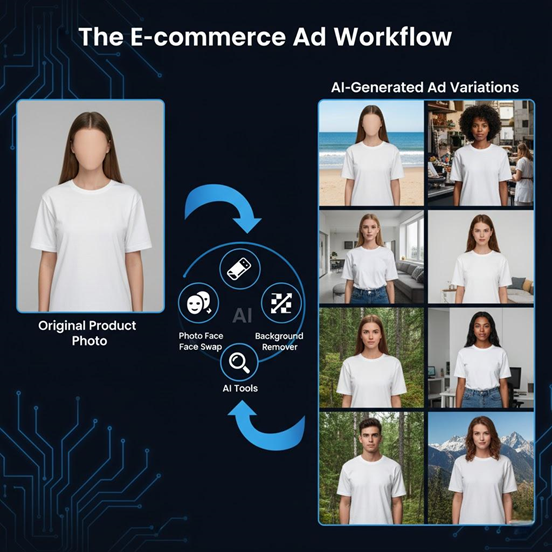
For digital marketers and e-commerce brands, the biggest expense and bottleneck is often creative production. Traditional photography is expensive, time-consuming, and generates static assets that quickly lead to advertising fatigue. This is where the strategic image AI face swap workflow becomes a game changer. We are not just talking about simple exchanges; We are discussing a generation engine for hyper personalization. Imagine that you are launching a new clothing collection. Now, you can use a high-quality product lens and utilize photo facial swapping to create dozens of variations, each tailored to a specific audience, instead of shooting a model and showing an advertisement to all. You can A/B test which “model” (i.e. which face) resonates the most with female viewers aged 18-25 and male viewers aged 30-45 without having to reshoot.
But to do this professionally, you must use a ‘stacked’ workflow. A common mistake is using low-quality source images, resulting in blurry and unconvincing exchanges. The professional workflow is as follows:
- Enhancement priority: Before considering exchange, run the source facial photo through the image enhancer first. This AI driven tool will improve resolution, sharpen details, correct poor lighting, and provide the high-quality data needed for facial swapping AI.
- Isolation theme: Use background remover on the main product image (e.g. model on white background). This provides you with a clean PNG format.
- Perform swapping: Perform image AI face swap by applying various high-resolution source faces to isolated subjects.
- Recombination: Place your new, diverse “model” on any number of new, relevant backgrounds.
In one afternoon, you turned a product photo into 50 unique and targeted advertising ideas. This is not just a ‘face swap’; This is an end-to-end production process that can save thousands of dollars and significantly improve ad relevance and conversion rates.
The Filmmaker’s Fix: Leveraging Video AI Face Swap in Post-Production
Although static images are powerful, there is no doubt that the holy grail of this technology is video AI face swap. This is also the biggest technical challenge. Artificial intelligence must track faces frame by frame in 3D space, taking into account constantly changing expressions, speech, and fluctuating light sources. For filmmakers and video producers, this technology is not so much about “deepfakes” as it is about solving problems in post production. Imagine that you have filmed a perfect interview, but due to a prominent marker in the background, the speaker’s B-roll lens cannot be used. Alternatively, you may need to use granular and low resolution archival recordings. Video face swap may be a solution, but it is only a part of the larger recovery process.
This is the workflow for “digital recovery”:
-Step 1: Clean the canvas. Your first step is to run the problematic lens through a watermark remover. This artificial intelligence tool can intelligently analyze videos and draw distracting logos or screen text, providing you with a clean working environment.
-Step 2: Improve quality. The old lens is 720p, which looks very soft on the 4K timeline. The next key step is video upscale. This AI will increase the resolution of the entire clip to 1080p or 4K, sharpening details and reducing graininess.
-Step 3: Perform the exchange. Now that you have a clean, high-resolution canvas, you can perform video face swap. Perhaps you need to morally anonymize speakers, or even ‘de age’ them. Due to the use of high-quality and clean data by artificial intelligence, facial tracking will be stable and lighting integration will be more realistic.
Another common use is for digital stunt work. Actors’ faces can seamlessly be exchanged onto the bodies of professional stunt performers, saving a lot of time and money on complex CGI or dangerous actual effects. In all of these cases, video face swap is the last powerful step in the artificial intelligence recovery toolchain.
The Virality Engine: Creating Next-Level Social Content with GIF and Expression Swaps
In the fast-paced and fiercely competitive world of social media, the goal is to immediately engage and share. This is where the creativity and often humorous applications of facial swapping technology truly shine, especially in the aspect of gif facial swapping. GIF is the currency of social media, but most of them are low-quality, pixelated, and overused. A ‘pro’ social media manager can create branded, high fidelity, and standout memes. Workflow? You guessed right – this is a ‘stack’. You first need to find the original video source, rather than swap face with a blurry “blinking white person” GIF. You can run the clip through a video scaler to create a clear high-definition version. Then, you use high-resolution photos of the brand CEO, mascot, or related influencers for GIF face swap. The result is a professional, high-quality meme that strengthens your brand, not just a low-intensity post.
But the next level of social content goes deeper. A common issue with exchange is emotional mismatch – the swapped face is neutral, but the body language or background is highly emotional. This is where the facial expression modifier comes into play. This subtle but powerful tool allows you to capture exchanged videos and adjust microexpressions afterwards. You can add a subtle smile, open your eyes wide in surprise, or add a caring frown. This increases the final 10% of realism that deceives the human eye. For TikTok and Reels, you can go further. Combine video face swap with speech cloning tools. Now, not only can you have a ‘historical figure’ appear in your videos, but you can also ‘say’ an interesting and relevant script using a synthesized version of their own voice. The combination of visual and audio artificial intelligence is at the absolute forefront of viral content creation.
The Future of the Integrated Creator: Ethics and the All-in-One AI Studio
The central theme of this script is clear: the power of facial swapping technology lies not in an isolated tool, but in an integrated workflow stack. We are witnessing a significant transformation in the creative industry, shifting from a series of disjointed, single purpose applications to comprehensive, integrated AI creative suites. The future is not about having ten different artificial intelligence subscriptions; This is about having a platform where all these tools can seamlessly ‘talk’ to each other. This is exactly the vision of platforms such as faceswap-ai.io. The goal is to create a unified environment where creators can upload a file and adjust their emotions through video scaler, watermark remover, video face swap, and finally facial expression modifier – all in a logically clear and non-destructive workflow.
Of course, this immense power also brings an equal degree of moral responsibility. The term ‘deepfake’ carries a heavy negative connotation for a reason. As professional creators, we must become pioneers in ethical use. The clear line must always be agreement and intention. Using facial swapping for imitation, art, film production (such as digital stunt doubles), or choosing to incorporate e-commerce personalization is a revolutionary creative behavior. Using it for misinformation, harassment, or the production of unauthorized pornographic content is a red line that cannot be crossed. The long-term health of the entire creative field depends on our commitment to transparency and ethics. The future of content creation will be defined by those who master the stack – creators who can cleverly combine image enhancers, background removers, voice clones, and facial swapping tools to tell stories and create experiences that were previously impossible.