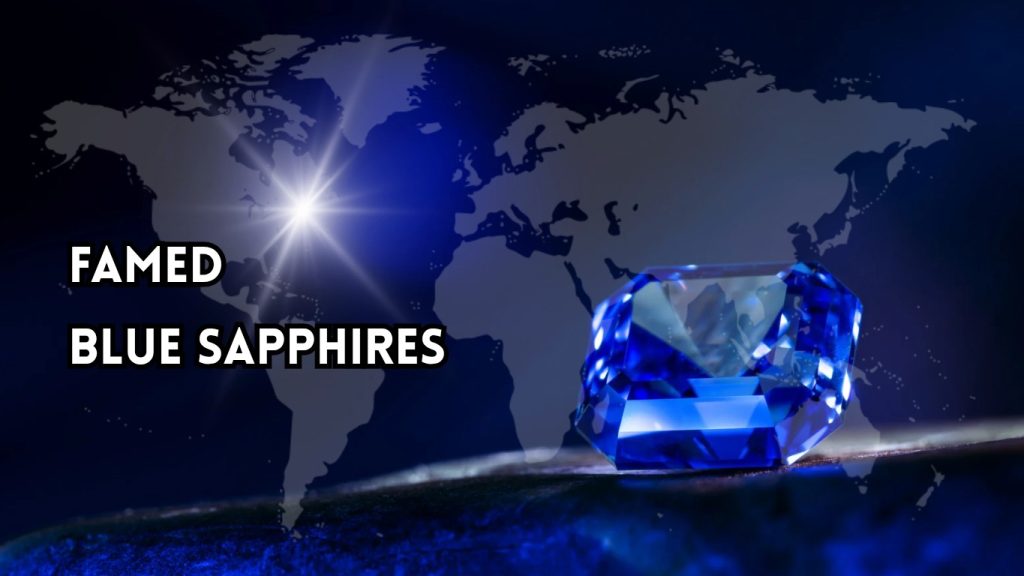
The cool, velvety “cornflower” blue of Kashmir sapphires occupies a special place in the history of gems. The original Kashmir deposits were discovered in the Zanskar range of the Himalayas in the early 1880s and — because the richest pockets were unusually concentrated and short-lived — the mines produced only for a few years (roughly 1881–1887) before largely being exhausted. That short working window, extreme elevation and the distinctive, highly saturated yet soft blue tone combined to create a small output of exceptional, highly sought stones whose fame has only grown with time.
KASHMIR SAPPHIRES
Kashmir sapphires are prized not only for their hue but for their even, velvety saturation and fine clarity; untreated Kashmir sapphires of good size are vanishingly rare and command extraordinary prices when they appear at auction. Important Kashmir pieces — such as the “Jewel of Kashmir” and recent auction stars often described as “unheated royal blue” — repeatedly set per-carat records, underlining collectors’ appetite for that particular provenance.
Fine quality Kashmir blue sapphires in large sizes have generally disappeared from the collector’s circuit. While mining has stopped over a century ago, present owners of these legendary sapphires are unwilling to put them up for sale. The excitement surrounding rumors about a big Kashmir sapphire that, was sold to a European collector about a century ago – is understandable. The narrative is about a big cushion diamond that, Maharaja Pratap Singh of Kashmir inherited from his predecessor, Maharaja Ranbir Singh.
THE SPIRIT OF KASHMIR
In 2023 the Guinness World Records recognized “The Spirit of Kashmir” — a 150.13-carat cushion-cut Kashmir sapphire — as the largest Kashmir sapphire on record, a remarkable modern confirmation of how coveted stones from that name remain. Exceptionally fine Kashmir gems (for example, pieces in the 27–35 carat range) break per-carat records, reinforcing the market distinction between true Kashmir provenance and other celebrated sources.
ZANSKAR CROWN SAPPHIRE
There is some debate on the name of this historic Kashmir sapphire. While most reports refer to the big cushion sapphire as the Zanskar Crown, a few commentators seem to be convinced that the gem was named Zanskar Blue. However, since the general narrative remains the same, not much importance is being given to the name at this point. Experts eagerly await the moment when documentation surfaces, the Zanskar Crown remains more legend than confirmed gemological fact — a prince of myth in the world of fine sapphires.
CEYLON SAPPHIRES
By contrast, Ceylon (modern-day Sri Lanka) has been a long-running and prolific source of fine blue sapphires for centuries. Ceylon sapphires are typically prized for lively, bright blue tones combined with excellent transparency; they appear across a wide range of sizes, from small brilliant gems to very large faceted stones and spectacular star sapphires mined around Ratnapura. The sustained gem yield from Sri Lanka means famous royal and historic sapphires frequently trace to “Ceylon” as their origin.
‘LADY DIANA SAPPHIRE’
A good example of the Ceylon connection in modern royal jewellery is Princess Diana’s engagement ring: the central stone is a 12-carat oval Ceylon (Sri Lanka) sapphire set within a halo of 14 diamonds. Selected from Garrard’s catalogue in 1981, its brilliant, saturated Ceylon blue helped make the design instantly iconic — and the ring later became the engagement ring of Catherine, Princess of Wales.
SUMMARY
The auction of historic blue sapphires is a rare event today, largely because very few of these exceptional gemstones remain traceable through history. Many famed sapphires from the 19th and early 20th centuries have either disappeared from records, been reset into modern jewelry, or passed into private collections where they remain unseen. Kashmir blue sapphires, in particular, were mined for only a brief period in the late 1800s, making their surviving examples exceptionally scarce. Similarly, fine Ceylon blue sapphires with documented provenance are limited, as most were acquired by royal families and elite collectors’ generations ago.
Current owners of these historically significant sapphires appear to be in no rush to sell. The emotional, cultural, and sometimes dynastic value attached to such gems often outweighs financial considerations. Moreover, collectors understand that the rarity of traceable Kashmir and Ceylon sapphires is likely to increase with time, further enhancing their prestige and value. As a result, major auction houses seldom get the opportunity to feature such stones, and when they do, the events attract global attention. The combination of limited supply, strong private ownership, and historical significance explains why auctions of these legendary blue sapphires have become so uncommon today.