A few months ago I was talking to a property manager in Vaughan who had just signed a contract with a cleaning company and was already regretting it. Not because the company was bad at what it did. By all accounts they were fine. The problem was that what they did wasn’t what his building actually needed. He had a mixed-use commercial property, with some professional office tenants on the upper floors and a light manufacturing operation on the ground level, and he had hired a standard office cleaning service to handle the whole thing.
The office floors looked great. The ground level was a different story. The cleaning crew wasn’t equipped for what they found down there. They didn’t have the right products for industrial-grade grease accumulation. They weren’t trained to work around machinery in the way that environment required. The manufacturing tenants complained. The property manager ended up paying for two contracts when a better initial conversation with the right provider could have produced one that actually fit what he had.
That story comes up in my mind every time someone tells me they’ve “sorted out the cleaning” without really being specific about what type of cleaning they’ve actually arranged. Because the type matters. It matters more than most people who haven’t thought carefully about it realize.
Office Cleaning: What It Is and Who Actually Needs It
Office cleaning is the most familiar category, which is partly why it’s the most frequently misapplied. People hear “commercial cleaning” and they think office cleaning, even when the space they’re managing isn’t really an office environment.
Genuine office cleaning is designed around the specific characteristics of professional workspace environments, relatively clean surfaces, moderate foot traffic, shared amenities like kitchens and washrooms, client-facing areas that need to maintain a presentable standard, and the kind of general-purpose contamination that comes from dozens of people spending their working days in an enclosed space. Desks, conference rooms, reception areas, washrooms, kitchens, floors, these are the domains of office cleaning, and the protocols are calibrated to what those environments accumulate.
What office cleaning is not designed for is significant chemical exposure, heavy particulate accumulation from industrial processes, machinery-adjacent cleaning, or the kind of grease and fluid management that comes with manufacturing or food processing environments. Apply an office cleaning protocol to those contexts and you’ll get surfaces that look somewhat better but aren’t actually clean at the level the environment requires.
If your business operates from a professional space, consultancy, agency, financial services, medical office, law firm, or tech company, office cleaning done properly is what you need. The emphasis is on consistency, presentation, sanitation of shared spaces, and maintaining the kind of environment that supports productive, healthy work over a full working week.
Industrial Cleaning: A Completely Different Scope
Industrial cleaning operates in a different universe from office cleaning, and the distinction isn’t just about scale. It’s about the nature of what needs to be cleaned and the hazards involved in cleaning it.
Industrial environments, manufacturing facilities, warehouses, food processing plants, automotive operations, light industrial units, generate contamination that office-grade cleaning products and equipment simply aren’t designed to handle. Grease accumulation on machinery and floors. Chemical residue from production processes. Heavy particulate from materials handling. Fluid spills that penetrate flooring in ways that surface cleaning can’t address. Some environments have biological contamination from food products or organic materials that requires a different level of disinfection entirely.
Industrial cleaning also involves working around equipment and processes in ways that require specific training. Knowing which areas can be cleaned during operating hours and which require shutdown. Understanding which cleaning products are compatible with the materials and coatings present in the facility. Recognizing the safety protocols that apply to the environment, confined spaces, chemical storage areas, elevated surfaces, and working within them correctly.
The cleaning companies that do this well have staff who are trained specifically for industrial contexts, not adapted from an office cleaning background. The equipment they bring, industrial degreasers, high-pressure systems, and specialized extraction equipment, reflects the actual demands of the environment rather than a scaled-up version of what works in a professional office.
If your business involves any kind of manufacturing, processing, or significant materials handling, the cleaning contract you need is not an office cleaning contract with a larger scope. It’s an industrial cleaning engagement built from the ground up around what your specific facility requires.
Janitorial Services: The Daily Maintenance Layer
Janitorial services occupy a different position in the cleaning landscape than either office cleaning or industrial cleaning, and understanding that position is important for businesses that are trying to build a complete maintenance picture for their facility.
Where office cleaning and industrial cleaning tend to involve scheduled visits, sometimes daily, sometimes several times a week, sometimes weekly depending on the scope and the environment, janitorial services are about ongoing, continuous presence. A janitorial team is typically on-site throughout the working day, handling the immediate maintenance needs that arise as the building operates rather than addressing accumulated cleaning at intervals.
Restocking washroom supplies before they run out rather than after. Addressing spills when they happen. Managing the entry points during a particularly wet winter day when foot traffic is tracking water and salt across the lobby continuously. Keeping common areas presentable through a busy afternoon when they’d otherwise deteriorate visibly between scheduled cleans.
For many businesses, janitorial coverage works alongside a scheduled deep cleaning program rather than replacing it. The janitorial team handles the day-to-day operational cleanliness of the building. The scheduled professional cleaning team handles the deeper, more systematic maintenance that keeps the underlying environment genuinely clean rather than just presentable on the surface.
Understanding whether your facility needs janitorial coverage, a scheduled cleaning program, or both is a question of how the space is used, how much foot traffic it carries, and what standard it needs to maintain consistently across the operating day.
Post-Construction Cleaning, The Category That Gets Forgotten Until It’s a Problem
Post-construction cleaning deserves its own mention because it’s the category most frequently overlooked during the planning of a renovation or new build, and the consequences of overlooking it tend to be more serious than people expect.
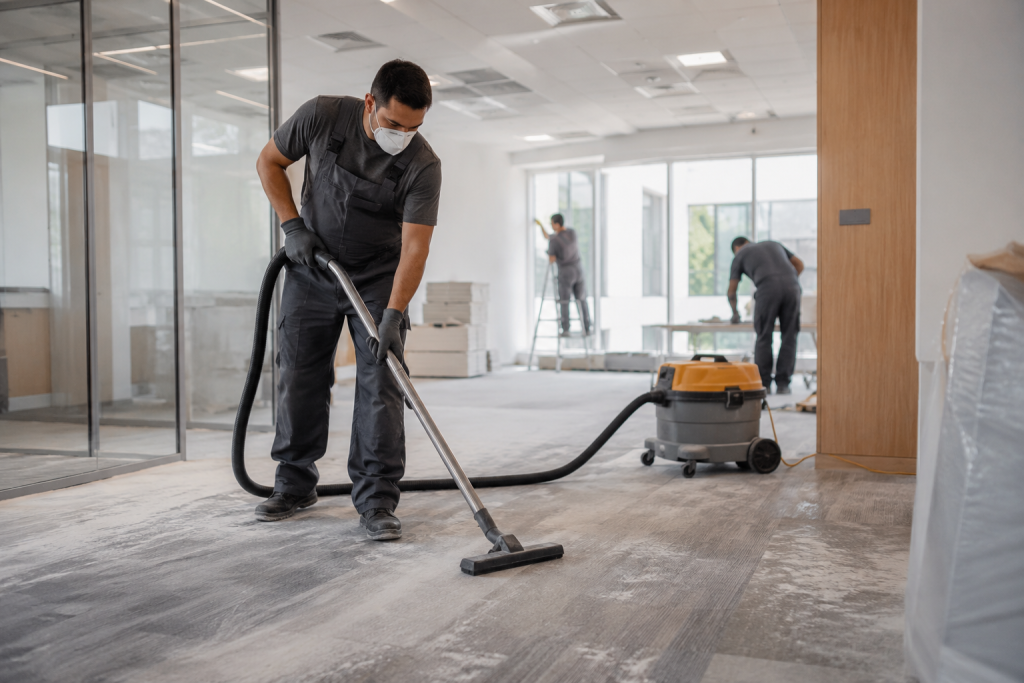
Construction work produces a specific and substantial contamination profile that none of the other cleaning categories are built to address. Fine construction dust that penetrates every surface, gap, and ventilation pathway in the building. Chemical residue from adhesives, paints, sealants, and primers that sits on surfaces and releases into the air as volatile organic compounds. Debris in locations that aren’t immediately obvious: inside ductwork, under raised flooring, behind newly installed fixtures. The kind of accumulation that a facility moving in without a proper post-construction clean will be managing the effects of for months without necessarily understanding the source.
Post-construction cleaning uses specialized equipment and protocols designed for this specific contamination profile. HEPA air scrubbers that filter construction particulate from the indoor air. Industrial vacuums with filtration systems appropriate for fine construction dust. Cleaning sequences that work systematically from high surfaces down to floors to prevent recontamination of already-cleaned areas. The scope is specific, the timeline matters, and the results of doing it properly versus skipping it are genuinely significant for the health of the people who will occupy the space.
Choosing the Right Type, and the Right Provider for It
The practical challenge for most businesses isn’t identifying which category they fall into; that’s usually fairly straightforward once the categories are clearly defined. The harder challenge is finding a provider who is genuinely equipped to deliver the right type of service rather than adapting a general approach to a context it wasn’t built for.
This is where asking specific questions during the selection process pays off. Does the provider conduct an onsite visit before proposing anything? A company willing to quote on a facility without seeing it is making assumptions that are likely to produce the kind of mismatch my Vaughan property manager ended up with. Do they have specific experience in the type of environment you’re managing? References from similar facilities, not just from cleaning clients in general, are worth asking for. Can they articulate clearly what their protocols are for your specific environment and why those protocols are appropriate?
Professional commercial cleaning services that operate across multiple cleaning types, office, industrial, janitorial, post-construction, bring something valuable to this conversation that narrowly specialized providers don’t. They’ve seen enough different environments to understand the distinctions, to know when a hybrid approach is needed, and to build a cleaning program that reflects what a facility actually requires rather than what’s easiest to deliver.
That’s precisely what makes elite cleaning services across the GTA worth engaging with properly, not just asking for a quote, but having a real conversation about what your space is, how it’s used, and what type of professional cleaning it genuinely needs. The property manager in Vaughan learned that lesson the expensive way. Most businesses don’t have to.