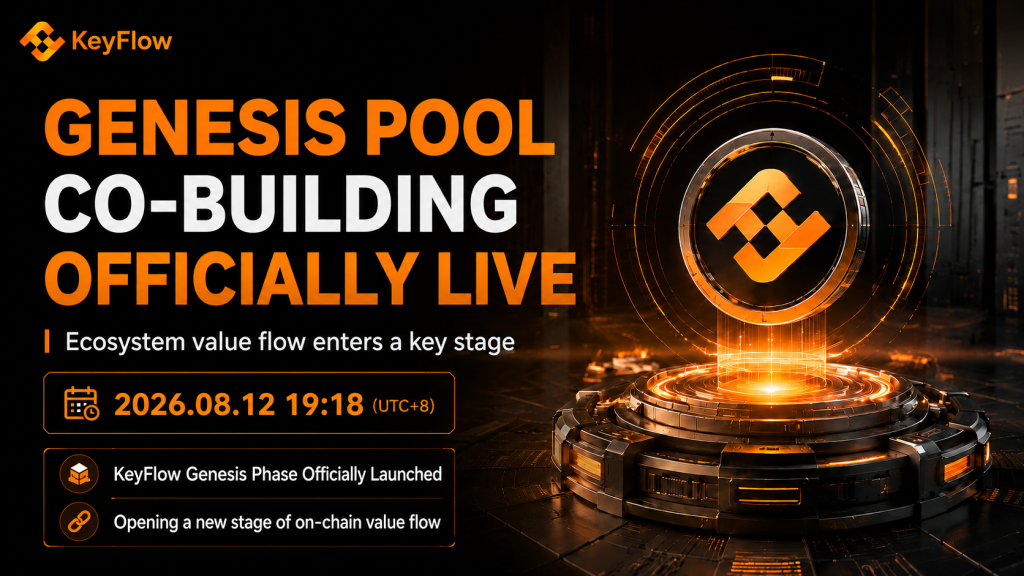
KeyFlow has officially launched its Genesis Pool Co-Building program, introducing a new ecosystem model that aims to connect artificial intelligence infrastructure with blockchain-based value settlement.
The Genesis Pool officially opened at 19:18 on August 12, 2026, UTC+8. The launch introduces two major mechanisms, including an early-bird conversion program and 360-day Intelligent Computing LP Orders.
According to KeyFlow, the initiative is designed to establish an initial liquidity treasury while giving participants a structured way to engage with the growing AI Agent economy.
The launch also strengthens the connection between KeyFlow and UniKey. UniKey focuses on AI infrastructure and access to computing capabilities, while KeyFlow is positioned as the settlement and value circulation layer supporting that infrastructure.
Together, the two platforms are designed to create a broader ecosystem linking AI services, computing power, liquidity, and token-based economic activity.
AI Is Creating Demand for New Infrastructure
Artificial intelligence has moved far beyond experimental technology.
Large language models, AI Agents, automation systems, image-generation platforms, APIs, and intelligent applications are becoming increasingly common across industries.
Behind these applications is a growing need for computing power.
Developers require access to AI models. Businesses need reliable APIs. AI Agents depend on computing resources to perform complex tasks. As adoption increases, the demand for efficient access to these resources is also growing.
Yet advanced computing infrastructure can remain expensive and difficult for smaller participants to access.
KeyFlow is attempting to address this challenge by developing a settlement framework around the economic activity generated by AI infrastructure.
The KeyFlow and UniKey Ecosystem
KeyFlow and UniKey serve different but connected functions.
UniKey represents the AI capability layer.
KeyFlow represents the value settlement layer.
This dual structure is intended to connect technology with economic activity.
UniKey Provides the AI Capability Layer
UniKey is positioned as an AI infrastructure platform designed for the Agent era.
The platform brings together different AI models, computing resources, and workflow capabilities within a unified environment.
For developers and users, this can provide a more streamlined way to access AI services without having to manage every individual resource separately.
UniKey therefore forms the infrastructure foundation of the broader ecosystem.
KeyFlow Provides the Settlement Layer
KeyFlow focuses on the economic infrastructure surrounding AI usage.
The platform uses KEY as its central token and proposes mechanisms covering capital participation, token distribution, ecosystem revenue, liquidity, and market circulation.
KeyFlow states that revenue generated from AI services, API calls, and computing-power leasing can enter its proposed KEY buyback and burn mechanism.
The objective is to connect AI usage with an ecosystem-level value cycle.
Genesis Pool Opens a New Participation Framework
The Genesis Pool represents one of the most important elements of KeyFlow’s current development.
Its purpose is to create an initial liquidity treasury that can support the settlement network as it develops.
Participants contribute to the Genesis Pool, and KeyFlow states that smart contracts automatically convert those funds into 360-day Intelligent Computing LP Orders.
The orders are then placed into the ecosystem’s liquidity treasury.
This structure is designed to provide longer-term liquidity while establishing a defined settlement framework for participants.
Potential participants should review all applicable terms, smart-contract details, and financial risks independently before committing funds.
The 360-Day Intelligent Computing LP Order
At the center of the Genesis Pool is the Intelligent Computing LP Order.
The order operates over a stated 360-day period.
KeyFlow says the settlement process is connected to on-chain block records and follows a linear release model.
Under this structure, the amount generated through the mechanism is released progressively over time.
The platform states that available principal and returns can support daily withdrawals under the applicable conditions.
Participants can also choose to re-enter available amounts into the ecosystem.
The model is intended to provide a combination of long-term liquidity and progressive settlement.
Early-Bird Conversion Program
The Genesis Pool also introduces a time-based early-bird conversion mechanism.
KeyFlow states that participants who join during the first day receive a 35% discount settlement price.
Using the conversion formula provided by the project, a 100 USDT contribution would correspond to approximately 153.8 USDT worth of KEY allocation.
The calculation is:
100 ÷ 0.65 ≈ 153.8
The early-bird structure is designed to provide a stronger conversion rate to participants during the initial launch period.
Conversion Conditions Increase Over Time
The Genesis Pool does not maintain the same conversion conditions indefinitely.
KeyFlow states that the discount rate changes by 0.005 every 24 hours after the initial period.
This produces a step-up pricing model.
Participants entering during the earliest stage receive the most favorable stated conditions. Later participants enter under progressively adjusted terms.
The structure is intended to encourage early participation while creating a predictable transition toward subsequent settlement rates.
Because program conditions can change, users should verify the current terms directly through the platform before participating.
KeyFlow Introduces a Routing-Node Network
The project has also introduced a distributed routing-node framework alongside the Genesis Pool.
According to KeyFlow, users can activate an account as an active routing node with a 100 USDT contribution.
The objective is to expand the network and encourage collaboration among participants.
Routing nodes are intended to contribute to ecosystem promotion, distribution, and the broader computing-power network.
KeyFlow has created three additional participation levels for users seeking expanded roles.
These are the A1, A2, and A3 routing levels.
A1 Level Starts at 1,000 USDT
The A1 routing level is available to participants reaching the 1,000 USDT tier.
KeyFlow describes A1 as a basic service-provider node qualification.
Participants at this level can take part in the basic node structure and receive applicable referral revenue sharing connected to qualifying network activity.
The A1 level provides an initial path toward greater involvement in the network.
A2 Level Requires 5,000 USDT
The second tier is A2.
Participants reaching 5,000 USDT can qualify for the direct A2 routing level.
According to KeyFlow, this tier provides expanded agency and distribution support for computing-power tokens.
It also creates a more direct connection to the underlying computing-power monetization channel.
The A2 level is therefore positioned as an intermediate participation structure within the network.
A3 Level Opens at 10,000 USDT
The highest announced routing tier is A3.
Participants reaching 10,000 USDT can qualify for A3 status.
KeyFlow states that A3 participants receive higher-discount agency rights for computing-power tokens.
The platform also states that A3 participants can receive long-term revenue-sharing rights connected to 20% of network-wide SWAP fees.
These are project-specific participation terms and should be evaluated carefully alongside the current platform documentation and applicable risks.
KEY Connects the Ecosystem’s Economic Activity
KEY is positioned as the primary token within the KeyFlow ecosystem.
The project describes KEY as the link between AI computing resources and application services.
The token is incorporated into the proposed ecosystem model covering issuance, circulation, revenue mechanisms, liquidity, and buyback and burn activity.
The purpose is to create an economic connection between platform usage and token activity.
For the model to work sustainably, it will require meaningful AI usage, continued ecosystem adoption, sufficient liquidity, and effective execution.
Creating a Link Between AI Usage and Value
The central concept behind KeyFlow is relatively straightforward.
AI services require infrastructure.
Infrastructure generates usage.
Usage creates economic activity.
KeyFlow aims to create a settlement layer around that activity.
For example, an application may use an AI model through an API. An AI Agent may consume computing resources while completing a workflow. A business may lease computing power for its AI operations.
These activities create measurable demand.
KeyFlow seeks to connect that demand with its blockchain-based economic infrastructure.
Supporting the AI Agent Economy
The development of AI Agents is one of the major trends influencing the technology sector.
AI Agents can perform tasks that involve multiple steps and different digital services.
They may interact with APIs, analyze information, use software tools, communicate with other systems, and access different AI models.
As these capabilities become more common, the need for reliable computing infrastructure is likely to remain important.
KeyFlow is building its ecosystem around this emerging opportunity.
Its settlement framework is intended to support the economic activity associated with AI services and computing resources.
A Broader Ecosystem of Participants
KeyFlow’s long-term vision includes more than individual users.
The proposed ecosystem includes developers, AI users, service providers, routing nodes, computing-power participants, community partners, and liquidity providers.
Each group can play a different role.
Developers can create AI applications.
Users can consume AI services.
Computing providers can supply infrastructure.
Routing nodes can expand network distribution.
Liquidity participants can support the settlement ecosystem.
KeyFlow aims to connect these groups through a shared economic framework.
Establishing the Initial Liquidity Treasury
Liquidity is an important consideration for blockchain ecosystems.
Without sufficient liquidity, transactions and token exchanges can become more difficult.
The Genesis Pool is designed to provide KeyFlow with an initial liquidity foundation.
The 360-day LP Order structure is intended to maintain this foundation over a longer period.
This gives the project a mechanism for building liquidity while simultaneously creating a structured participation program.
The ultimate effectiveness of the approach will depend on actual ecosystem usage, market demand, liquidity levels, and network growth.
AI and Blockchain Move Closer Together
AI and blockchain are increasingly being combined in new technology models.
AI brings automation, intelligence, and computing requirements.
Blockchain provides programmable transactions, transparent records, and token-based economic systems.
KeyFlow is attempting to use blockchain infrastructure to create a settlement layer around AI-related economic activity.
The project’s relationship with UniKey provides the AI capability component, while KeyFlow provides the proposed economic infrastructure.
Building a Complete Value Cycle
KeyFlow describes its ecosystem as a connected value loop.
The process begins with AI infrastructure.
Users access AI capabilities through UniKey.
AI applications and Agents consume computing resources.
This generates service usage and economic activity.
KeyFlow then provides the settlement framework around that activity.
KEY serves as the central token in the proposed economic structure.
Revenue-related mechanisms, including the stated buyback and burn model, are intended to connect ecosystem activity with token circulation.
This creates the foundation of the value cycle KeyFlow is seeking to establish.
Why the Genesis Pool Is Significant
The Genesis Pool is significant because it brings several parts of KeyFlow’s ecosystem strategy together.
It introduces a liquidity mechanism.
It establishes an early-bird participation structure.
It creates the 360-day Intelligent Computing LP Order model.
It operates alongside the routing-node framework.
It supports the project’s broader objective of developing a blockchain settlement layer for AI activity.
The launch therefore represents more than a new participation program. It marks a new stage in KeyFlow’s ecosystem development.
Lowering the Barrier to AI Participation
KeyFlow says one of its objectives is to make participation in the AI economy more accessible.
Advanced AI infrastructure can require substantial capital and technical expertise.
This can make it difficult for individual users and smaller developers to participate directly in the value generated by the expanding AI market.
KeyFlow’s model seeks to provide another route into this ecosystem.
The long-term success of this approach will depend on genuine platform usage, adoption, network activity, transparency, and sustainable development.
What the Future Could Bring
The AI Agent economy is still developing.
As intelligent applications become more capable, demand for computing power and AI services could continue to increase.
This creates opportunities for infrastructure providers, service platforms, and settlement networks.
KeyFlow is positioning its ecosystem around this potential growth.
The Genesis Pool is intended to provide the initial financial and liquidity foundation for that strategy.
Future development will determine whether the platform can translate its proposed architecture into meaningful and sustainable real-world activity.
KeyFlow Genesis Pool Officially Goes Live
KeyFlow officially launched its Genesis Pool Co-Building program at 19:18 on August 12, 2026, UTC+8.
The launch combines UniKey’s AI infrastructure with KeyFlow’s proposed settlement network.
The Genesis Pool introduces the early-bird conversion system and 360-day Intelligent Computing LP Orders.
The routing-node system provides another mechanism for expanding participation.
The A1, A2, and A3 tiers add further levels to the network’s proposed distribution structure.
Together, these components establish the initial framework for KeyFlow’s next stage of development.
Building Toward an AI-Powered Value Network
The continued growth of AI will require more than increasingly capable models.
It will also require computing infrastructure, APIs, intelligent applications, data services, and economic systems capable of supporting those technologies.
KeyFlow is attempting to position itself within this broader infrastructure landscape.
Its partnership with UniKey creates a connection between AI capabilities and blockchain settlement.
The Genesis Pool provides the initial liquidity mechanism.
The routing network expands participation.
KEY provides the proposed economic connection.
As the AI Agent economy develops, KeyFlow will seek to demonstrate that these components can operate together as a sustainable ecosystem.
Final Perspective
The launch of the Genesis Pool marks a new chapter for KeyFlow and its broader AI ecosystem strategy.
By combining AI infrastructure, computing resources, liquidity, routing nodes, and blockchain-based settlement, the project is attempting to create a new economic framework for the Agent era.
The Genesis Pool provides the initial foundation for that effort through its early-bird conversion model and 360-day Intelligent Computing LP Orders.
Its long-term success will ultimately depend on real adoption, transparent execution, sustainable economic activity, and continued demand for AI infrastructure.
KeyFlow’s official DApp is available through https://www.getkeyflow.ai for users who want to explore the platform and its latest ecosystem developments.
With the Genesis Pool now live, KeyFlow is beginning its next phase of development with a focus on connecting AI capabilities and decentralized value settlement.