Introduction
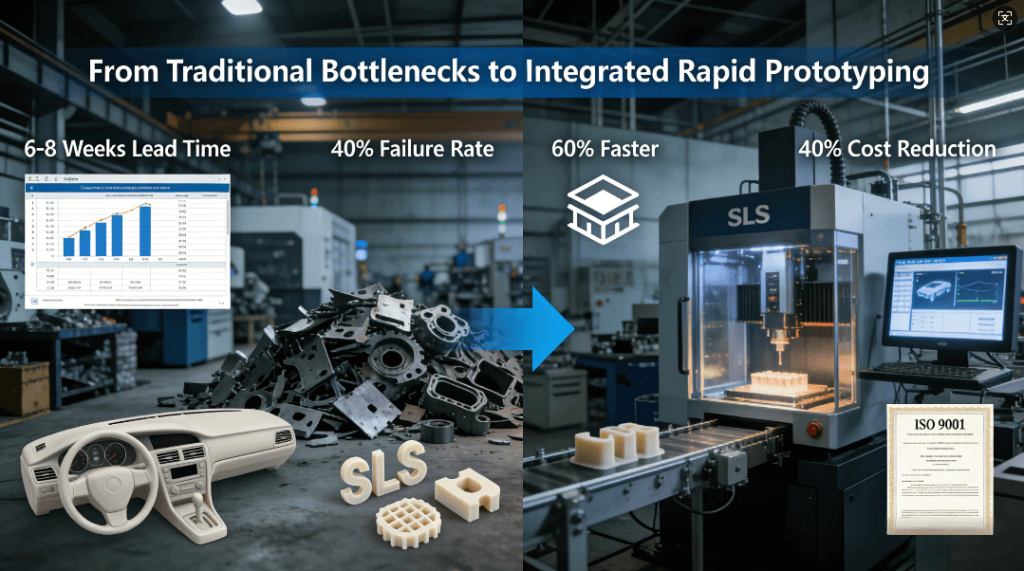
Within a highly competitive environment like the automobile sector, prototype development is a key sensitive process. While developing prototypes, project management often faces issues of prohibitively expensive prototype development, i.e., costs going out of control, an extended period of 6-8 weeks, and even a higher testing failure rate of up to 40%. The reasons for such difficulties, which directly impact project budgetary issues as well as timely product launches, correlate to using conventional design optimization techniques, such as a single-process CNC machining technique or a conventional 3D printing technique, that cannot be explored as an integrated solution.
In the current state, a revolutionizing alternative is being offered in the form of a comprehensive approach towards rapid integration, as discussed further in the subsequent sections. It is possible to obtain a 60% reduction in development cycles, as well as a 40-50% decrease in costs, by adopting a wise integration of sophisticated approaches like SLS printing and vacuum casting, accompanied by informed material selection approaches.
What Are the Top Challenges in Traditional Automotive Prototyping and How Can They Be Overcome?
The traditional methods of prototyping, although they were the order of the day in the industry in the past, today have turned into a major bottleneck for the industry in terms of innovation costs and expenses. Now, first things first!
- High Cost and Inflexibility of Hard Tooling: However, the reliance on injection molding for prototypes leads to the need for expensive molds made of materials such as steel or aluminum, which can exceed financial costs of tens of thousands of dollars. It further proves to be a huge risk, particularly for unvalidated designs, as even a minor change in the design following its creation results in a new, or substantially altered, mold, thereby causing costs to shoot up again.
- Slow Iteration Cycles and Delayed Feedback: Particularly, if the prototype needs to be set up several times on various machines, as is the case when prototyping is needed for elements made of metal as well as plastic cases — but use different manufacturing processes — the time to make changes to the single design can escalate into weeks. This disjointed workflow, which involves a significant delay between the design, creation, and assembly processes, means that design and performance problems are only detected close to the end of the project, which is when any challenges appear to be most expensive and time-consuming to rectify.
- Quality Inconsistencies and Validation Gaps: In addition, obtaining these individual components for a given prototype from different suppliers would also mean that differences exist in terms of material qualities, finish, and even size. This would then pose a problem when it comes to obtaining a global view of how well a given product would perform or how poorly it would do. A holistic view, formalized within a system like that contained within the ISO 9001 quality system, is crucial to ensure that every individual component for a given prototype is held to a high standard.
How Does Rapid Prototyping Balance Aesthetics and Functionality for Car Dashboard Designs?
The interior of modern cars, especially the dashboard, is a complex system that requires not only artistic excellence but also performance excellence. Rapid prototyping has distinct strengths in providing exact replicas of the final product, especially concerning its shape and performance, to its users.
1. Creating a Functional Core with Advanced Additive Manufacturing
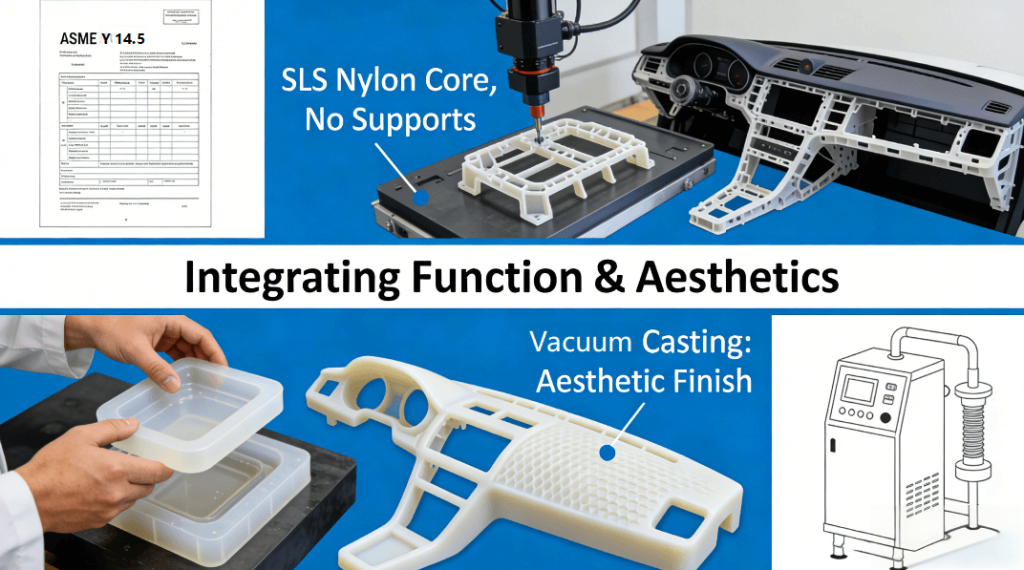
The structural skeleton of a car dashboard with its complex air ducts, mounting holes, and wire channels can also be directly 3D printed with a Selective Laser Sintering (SLS) process employing nylon materials. This enables the printing of a complex internal structure in a single part without having to deal with the difficulties ofremoving support structures used in case of other 3D printing techniques. The 3D print consists of a strong and heat-resistant part that easily accommodates all internal components, including the infotainment system and climate controls.
H3: 2. Achieving Production-Quality Surfaces with Vacuum Casting
Once the functional SLS core is created, the aesthetic surfaces can be developed. This is done by creating a silicone mold out of the “master model” (which can be anything from a high-resolution 3D print to a traditional model) and then using a method known as vacuum casting to create finished-looking parts out of materials such as polyurethanes, which have the “look, feel, and even grain” of finished automotive parts. With this method, designers can test the “look and feel” of the final dashboard and its relationship with other interior trim pieces long before any tooling is done.
H3: 3. Ensuring Accuracy for Smooth Integration
A dashboard needs to integrate seamlessly into the vehicle’s instrument cluster, center console, and A-pillars. That would require tight control over all the interfaces. Looking back at standards such as ASME Y14.5 for GD&T, one can ensure that the digital design intent is appropriately converted into the physical prototype. This level of precision is crucial when having to validate an assembly process where the final vehicle has no squeaks or rattles and where everything is correctly aligned. To have a deep dive into material and process selection for such applications, engineers could refer to expert guides on rapid prototyping automotive parts.
H2: What Test Standards are Crucial at the Prototype Phase for Engine Components?
The metal components of an engine have to function in the harshest conditions in a vehicle. Component prototypes, such as intake manifolds, turbocharger housings, and sensor brackets, need validation for preventing catastrophic field failure by rigorous performance standards.
H3: 1. Validation under Extreme Thermal and Pressure Cycles
Parts are tested with thermal cycling that closely imitates how the heat from the engine bay and subsequent cooling during operation come and go in the extreme case. There also pressure tests: components need to withstand forces of at least 1. 2 MPa without getting deformed or leaking. By making prototypes out of materials such as carbon, fiber, reinforced nylons or high, temperature resins, engineers are able to get important performance data very early in the design phase that demonstrate the weak points of a certain design, if any.
H3: 2. Structural and Vibration Testing for Durability
Besides static testing, a prototype has to endure vibration and shock testing, which simulates the hostile environment of a running engine. This ensures how well a component handles the vibrations, checks the mountings, and also validates all the welded and/or bonded joints in assemblies. The data collected is used as input for Finite Element Analysis (FEA), thereby creating a digital twin for further iterations.
H3: 3. Adherence to Industry-Specific Quality Frameworks
Additionally, the auto industry and aviation industry have a similar requirement in terms of “extreme reliability.” Citing quality standards, such as those indicated by the International Aerospace Quality Group (IAQG), which publish their own set of AS9100 series documents, provides a solid foundation for all quality assurance issues, even though the documents are intended specifically for the aerospace industry, as this also corresponds to best practices in risk assessment, traceability, and process validation, which are pertinent to auto industry prototyping where every test must be traceable, repeatable, and audit-worthy.
H2: How Can Material Selection Help Reduce Costs by 30-50% for Automotive Prototyping Projects?
One of the most potent leverage points for cost reduction exists in strategic material selection. Beyond what is often referred to as a “one-material-fits-all” approach to prototyping, a tiered strategy based upon parts function can be a powerful solution.
H3: 1. Tiered Material Strategy Based on Functional Requirements
Not all the parts of a prototype have to be made out of the same production material as the final product. One way to save money is to:
- Visual/Form & Fit Models: Use very cheap standard resins or plastics. The aim is to verify the dimensions, shape, and assembly, not the mechanical properties.
- Functional Test Parts: Pick engineered materials that provide a giveaway of the key performance features (for instance, stiffness, heat deflection temperature) of the final material but at a much reduced cost. An example would be a high, performance ABS blend instead of an expensive, certified nylon.
- Pre, Production Validation Parts: At this stage, the performance and manufacturability are confirmed by signing off the use of the exact or nearly exact production material.
H3: 2. Leveraging Material Science Databases
Informed material selection decisions necessitate access to robust data sets. For example, the National Institute of Standards and Technology (NIST) material databases offer reliable data regarding the properties of thousands of various materials, which enables the comparison of the relative merits of potential materials from a scientific viewpoint. This enables the selection of the most cost-effective material while meeting all required prototype testing criteria without waste money on lux materials.
H3: 3. Reducing Waste and Streamlining Logistics
This also means that by selecting materials that are easily accessible and which are readily useable with fast-turnaround processing (like common 3D printing materials or casting resins), less time and lower minimum order quantities are required to fulfill a process. It is also noted that some advanced prototyping materials are less wasteful or require less post-processing cost. This approach to understanding all aspects of the cost of prototyping is important for achieving these 30-50% savings targets.
H2: What Are the Most Economical Solutions for Small-Batch Production of Automotive Parts?
For niche vehicles or other products with small production runs, the distinction between prototyping and low-volume manufacturing is often blurry. Availability of cost-effective solutions for a batch size of anywhere from 50 to 500 is necessary.
H3: 1. Vacuum Casting for Mid-Volume Plastic Components
Vac castings can be exceptionally cost-effective for producing volumes of 50-200 high-quality plastic parts. A single master model enables the making of a flexible vacuum mold that enables multiple parts to be made using polyurethane. Nothing like an expensive injection mold is needed, and good finishes as well as the ability to make parts from materials similar in final form to engineering plastics make this a strong option. The individual part costs are significantly lower than single-shot 3D Printing.
H3: 2. Rapid Tooling for Metal and High-Volume Plastic Parts
In cases where a greater volume or metal parts are a necessity, the quick tooling methods are activated. This entails the application of processes, such as 3D printing or even high-speed machining, with the aim of making uncomplicated, financially less demanding tooling inserts, which are then employed in making plastic or metallic parts through an injection molding or die casting process. Though the cost per finished piece is somewhat greater in contrast with mass production techniques, the general tooling cost is reduced by 60-to-80%, with the required time being lessened from months to mere weeks.
H3: 3. Process Selection Based on Break-Even Analysis
The most economical solution will vary depending on the batch size, complexity, and material of parts. Organizations like the Society of Manufacturing Engineers (SME) offer benchmarks and methodologies to carry out a break-even analysis. Such analysis compares the total cost, i.e., tooling + parts cost, of all manufacturing methods at various production scales, thereby giving us data-driven answers to questions about what might be the best option in auto parts manufacturing.
H2: How to Evaluate an Automotive Prototyping Supplier for Quality and Speed?
Choosing an effective manufacturing partner may be as important as designing your approach from scratch. A good supplier acts like an extension of your own team of engineers.
- Multi, Process Integration Capability: A first, class vendor is not going to be tied to a single technology. Check their capability of giving an integrated package of services, industrial, grade 3D printing (SLS, SLA, DMLS) and vacuum casting to CNC machining and rapid tooling. This guarantees that they will select the right processes and will do them to your particular work rather than making your design fit the only technologies they have. Such partners as experienced CNC prototyping manufacturers that are good at such integration bring to you a considerable strategic advantage.
- Robust Quality Management and Certification: Certifications are the minimum level that should not be broken. Take for example ISO 9001:2015 which is a standard that defines the requirements for a quality management system. If you are running an automotive project IATF 16949 is the quality standard specifically for the automotive industry and it indicates that a supplier is well, versed with the automotive industry requirements including Advanced Product Quality Planning (APQP) and Production Part Approval Process (PPAP). Besides these, there are other certifications like ISO 14001 (environmental management) and AS9100D (aerospace) which indicate that the company is well disciplined, traceable and continuously improving its processes.
- Communication, DFM Expertise, and Responsiveness: The good partner should offer you timely Design For Manufacturability (DFM) input before you even start building a product, with suggestions to help reduce cost or enhance reliability without sacrificing functionality. Measure their communications approach and project transparency. Can they offer you a clear and comprehensive quote for a prototype quickly? Will they offer you regular project status reports? A good partnersupplier will make your process more efficient and prevent costly errors.
H2: Conclusion
Integrated rapid prototyping can thus be viewed as a revolutionary concept in the way automotive engineers can think and act in relation to product development. Moving beyond the current state of fragmented and traditionally applied product development methods and into a new era of strategic product development using cutting-edge methods and capable intelligent material science solutions can, in effect, resoundingly beat the traditional issues of cost, speed, and validation. Achieving a potential cost reduction of 40% and a time reduction of 60% by using all the resources available under a quality umbrella can, in fact, make all the difference in an age in which speed and efficiency are key defining factors.
H2: FAQs
Q1: What is the typical lead time for a functional car dashboard prototype?
A: Since rapid prototyping is incorporated, lead times as quick as 7-15 days become possible depending on the design complexity. This gets around traditional 8-week lead time issues through the use of preliminary approaches like SLS for structural elements and vacuum casting for aesthetics.
Q2: What is the economic advantage of small quantity production to mass production?
A: Vacuum casting techniques, as well as rapid tooling, also significantly reduce or totally eliminate the cost constraint associated with hard, permanent tooling. This therefore allows the cost per item when producing 50 to 200 items several times less, 1.5 to 2 times less, than the cost per item when considering mass production, since producing 50 to 200 units represents a small fraction of mass production.
Q3: Can the engine prototype be used for functional tests at high temperatures?
A: Yes, the reason being that new types of prototyping materials, for example, carbon fiber reinforced nyrton and resin materials, are developed and are able to withstand extreme conditions, and they can be validated by means of simulation tests that are able to simulate temperatures up to 300C and a pressure of 1.2MPa.
Q4: What file formats are required to get a quote for a rapid prototyping project?
A: Common and impartial formats are preferred for accurate quoting. These may include STEP, STL, or IGES format for saving 3D geometry data. Reliable suppliers may offer a detailed quote within 2-24 hours from receiving the aforementioned information and brief specifying requirements.
Q5: What ensures that your prototypes are built at a comparable quality to your production parts?
A: A quality level guaranteed thru a quality management system such as ISO 9001, IATF 16949, etc. It spans from certification of materials used, inspection of materials in process using tools like 3D scanners or CMMs, and all for an ultimate goal of achieving levels of 85% or 95% in terms of performance and dimensional consistency.
H3: Author Bio
The author, who is a precision manufacturing expert at LS Manufacturing, is a firm that specializes in helping automotive engineers and innovators tackle various complex prototyping and manufacturing problems, as they are certified by IATF 16949, AS9100D, and ISO 9001, enabling them to deliver quality solutions in no time. For a free project review and a DFM analysis to help accelerate your next automotive project, reach out to their specialists today.